

I’ve been involved in the online gambling industry for long enough to know that when things like “100%+ EV” get thrown around, there’s usually more than meets the eye, and they’re not always telling you quite what you think.
The same is very much true of the instant-rip world. As it’s evolved over the past few months, I’ve seen more and more platforms, blogs, and social media influencers promoting packs with advertised EVs of 100% or higher.
But what does it all mean? What is EV? Is it really possible to rip card packs online with a higher chance of winning than losing? And if so, aren’t the platforms losing money?
Today, I’m going to break everything down, show you all you need to know about EV, and dispel some of the rumors. Let’s start with the basics:
What Does EV Actually Mean?
EV stands for expected value. It’s the average amount you can expect to win or lose from something over a large number of attempts, taking into account all possible outcomes, and how likely each one is.
EV does not predict what will happen on any given attempt, but it does give you an idea of the average return over time.
In everyday life, EV can apply to lots of situations; buying a lottery ticket, entering a raffle, weighing up the potential returns of an investment, deciding whether to play a hand at the poker table, and, of course - opening trading card packs online.
When it comes to card ripping, there are three core things that determine a pack’s expected value:
- The Possible Outcomes: Which cards can you actually pull?
- The Probability: How likely are you to pull each card?
- The Value: How much is each card worth?
Multiply each card’s value by its probability of being pulled, add everything together, and you’ve got the average expected card value, per opening.
For example, if a pack costs $10 and the possible pulls have an average value of $10, that would equate to a 100% EV. If the average pull is worth $12, the EV would be 120%.
A 100% EV pack means the possible pulls have an average stated value equal to the pack price, but that does not mean you have a 100% chance of getting your money back. It also doesn’t tell you how much you could actually recover by selling a card.
For that? You need to look at the buyback rate, real sale prices, and any extra costs.
Want to see the actual EV formula?
Here’s what it all comes down to:
EV = ∑ᵢ₌₁ⁿ (Pᵢ × Vᵢ)
Looks quite intimidating, doesn’t it? In reality, though, it comprises just three things:
- Pᵢ = The probability of each possible outcome.
- Vᵢ = The value of that outcome.
- ∑ = Add the results together.
So, if you wanted to express expected card value as a percentage of the pack price:
EV % = (Expected Card Value ÷ Pack Price) × 100
This calculates the gross expected card value before any buyback discounts, selling fees, or other costs associated with the pull.
A Real Life Example from Collector Crypt
OK, so this can all sound pretty complex on the face of it; maybe you want to see how EV actually impacts your instant rips? Let’s look at Collector Crypt for an example.
In the screenshot below, you can see their Elite Pokémon Gacha Pack that costs $50 to open. At the time of us taking this screenshot, it displayed an expected value of $54.83 - working out to a 109.66% EV.
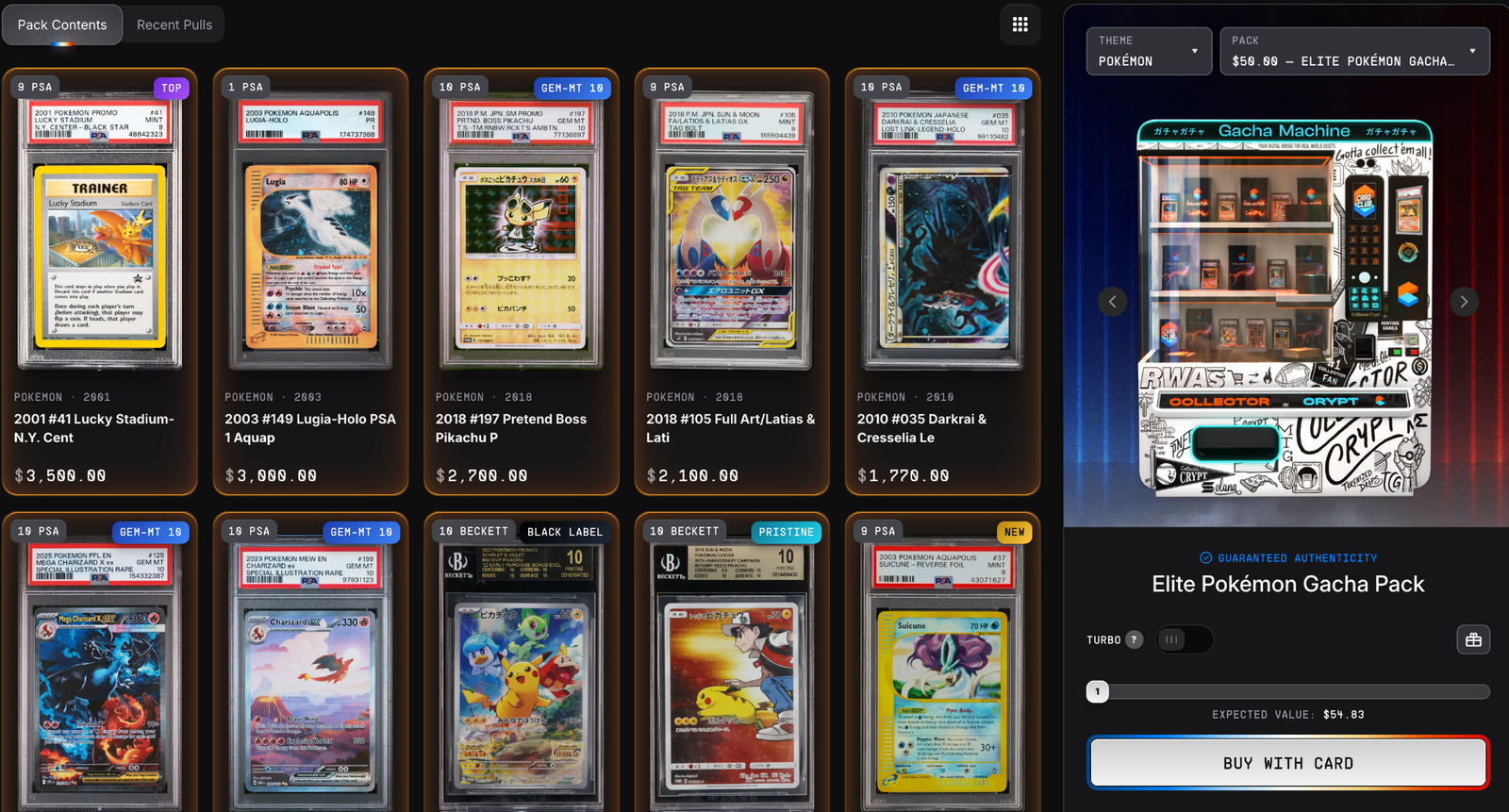
(The EV in this screenshot was accurate when I took it; it may well change when you view the pack. Collector Crypt also uses rarity tiers with different probabilities, so pulling a low-value Common card doesn't automatically improve your chances of landing a grail. Any changes to the cards available (and their valuations) will also impact the displayed EV.)
A 109.66% EV sounds pretty good. Rip enough packs and you’ll come out on top... right?
Well; not necessarily.
For starters, 100% EV doesn’t mean you have a 100% chance of getting your money back, and you could still be more likely to lose money from ripping a pack than making a profit...
And that’s before we even get into buyback rates, how platforms value their own cards, and what happens when you continue spending your winnings on more packs (ask me how I know!)
Why Most Pulls Lose on a “Fair” Pack
Imagine a fictional $10 pack drawing from a fixed pool of 1,000 cards, each with an equal chance of being selected. Together, those cards are worth $10,000, and that means the pack begins with an exact 100% EV
| Cards | Value each | Total |
|---|---|---|
| 800 | $4 | $3,200 |
| 150 | $12 | $1,800 |
| 45 | $40 | $1,800 |
| 4 | $300 | $1,200 |
| 1 | $2,000 | $2,000 |
| 1,000 packs | Average: $10 | $10,000 |
As you can see, the average card is worth exactly $10, but 800 of the 1,000 packs give you a $4 card - and only 1 in 5 is actually a winner. If you remove the single $2,000 card from the pack’s prize pool, the EV drops to about 80%, and this is why you’ll see pack EVs fluctuating so much.
As cards are pulled, removed, or added to a pack’s prize pool, its EV can change - sometimes quite dramatically. Of course, this depends on how the platform calculates EV, and whether it adjusts the odds.
The bottom line though is quite simple: is it better to open a pack advertised at 130% EV than one at 80%?
All else being equal, yes, absolutely.
Just know that a higher EV doesn't guarantee a profitable pull, or that you'll actually get back what the platform says your cards are worth.
How to Read a Pack’s Actual Odds
Now that you (hopefully) understand how EV actually works, you should realize that advertised EVs only tell you the average. To figure out the chance of getting your money back on an individual opening, you have to compare a few different things:
- Pack price: How much does it cost you to open/rip a pack?
- Odds: What chance do you have (in a percentage format) of landing in each value range?
- Card values: Which ranges are below the pack price, and which could give you a profit?
Let’s look at an actual example:
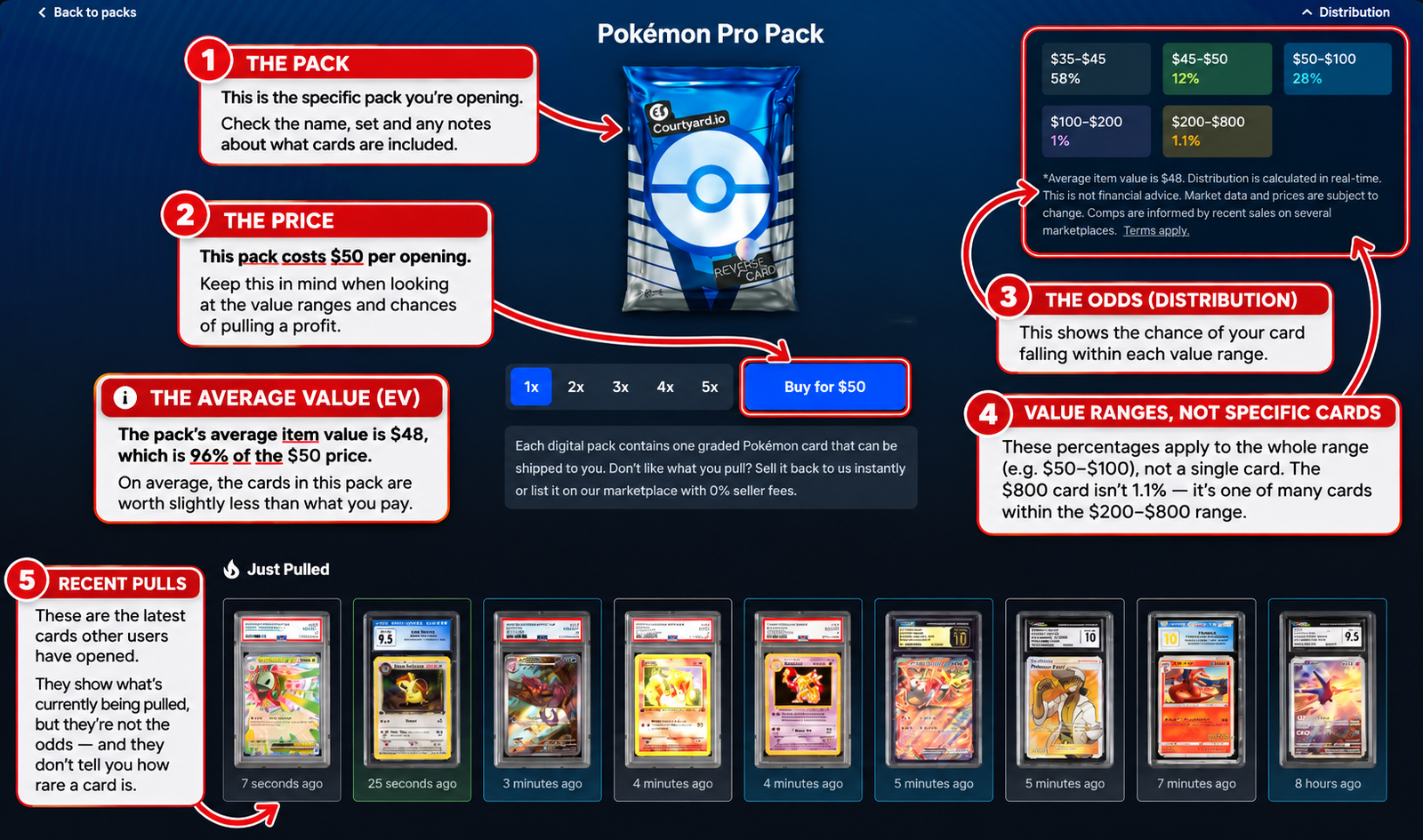
In this screenshot, I’m over at Courtyard, and you’ll see their Pokémon Pro Pack on the screen. It costs $50, and Courtyard displays an average card value of $48, so that’s equivalent to 96% of the pack price.
The odds show a 58% chance of a card valued at $35-$45 and a further 12% chance of one valued at $45-$50.
So, already? 70% of pulls fall at or below the price of the pack, and that’s still before any buyback discount or selling costs.
For the other bands, Courtyard says you’ve got a 28% chance of pulling a card worth $50-$100, a 1% chance of a $100-$200 pull, and a 1.1% chance of landing anywhere in the $200-$800 range.
What Does EV Actually Return After Buyback?
A pack's stated EV (what you see the platform advertising it at) is based on its estimated card values - but that isn’t necessarily what you'll get back. The difference becomes much clearer when you look at the platform's buyback rate.
Take again the Collector Crypt pack from our screenshot. It costs $50 and has an advertised EV of $54.83 (109.66%), but Collector Crypt lists an 85% instant buyback rate for its Elite pack.
That means the average buyback value would actually be:
$54.83 × 85% = $46.61
Or around 93.2% of what you paid.
When Is a High EV Actually Worth It?
At an 85% buyback rate, a pack would actually need around 117.65% advertised EV just to break even on average through instant buyback, and that assumes that no additional fees are involved.
And that helps to explain how platforms can advertise packs above 100% EV without automatically losing money: what they value their cards at isn’t necessarily what they’ll pay you for them.
And this is my entire issue with all of these influencers screaming about these “rare 100%+ EV packs making collectors rich”.
Sure, someone might pull a grail worth thousands of dollars from a $50 pack - walking away with a massive profit - but those are the exceptional pulls, and certainly not what the average collector should expect (nor me, given my recent ripping luck, apparently)!
What EV Doesn't Tell You
A pack's stated EV depends on the values assigned to its cards, often by the platform itself. Those numbers may not match real resale prices, and buyback rates, fees and shipping can change what you actually recover.
How much you can verify depends on the odds published. Exact per-card probabilities allow a theoretical EV calculation; broad value bands or rarity tiers may not. A 'provably fair' system can help verify a draw, but not whether the card valuations are reasonable.
And be cautious about 'hot' packs and public trackers. Short samples can swing wildly, and different trackers use different prices and time windows. Always check whether the number describes gross card value or actual buyback payouts.
Some Final Thoughts
This guide went on a little longer than I’d anticipated at first, but I wanted to explain EV all in one place. If there are any specific parts of it you’re struggling to get your head around, you’re welcome to reach out to me and I’ll do my best to clear things up for you.
Before we finish up, just a few last things I want to point out:
“Will opening more packs eventually give you the advertised EV?”
This is something I think a lot of collectors ask themselves, and the answer is: not necessarily.
Try to think of it like a slot machine’s RTP. A slot might have a theoretical return of 96%, but that doesn't mean you'll get $96 back every time you wager $100. One player could lose nearly everything in a session, while another could land a jackpot.
That exact same principle applies to opening card packs online, too. EV is a mathematical average, but it’s not a guarantee of what you'll receive after 10, 100, or even 1,000 openings.
Your 60-Second Check Before You Rip
- What's the pack price, and how likely are pulls worth less than that?
- What's the stated EV, and whose card values is it based on?
- What's the buyback rate, and is it paid in cash or site credit?
- Can you withdraw, and are there play-through rules?
- Have you set a budget you won't top up with buyback credit?
